
Introduction
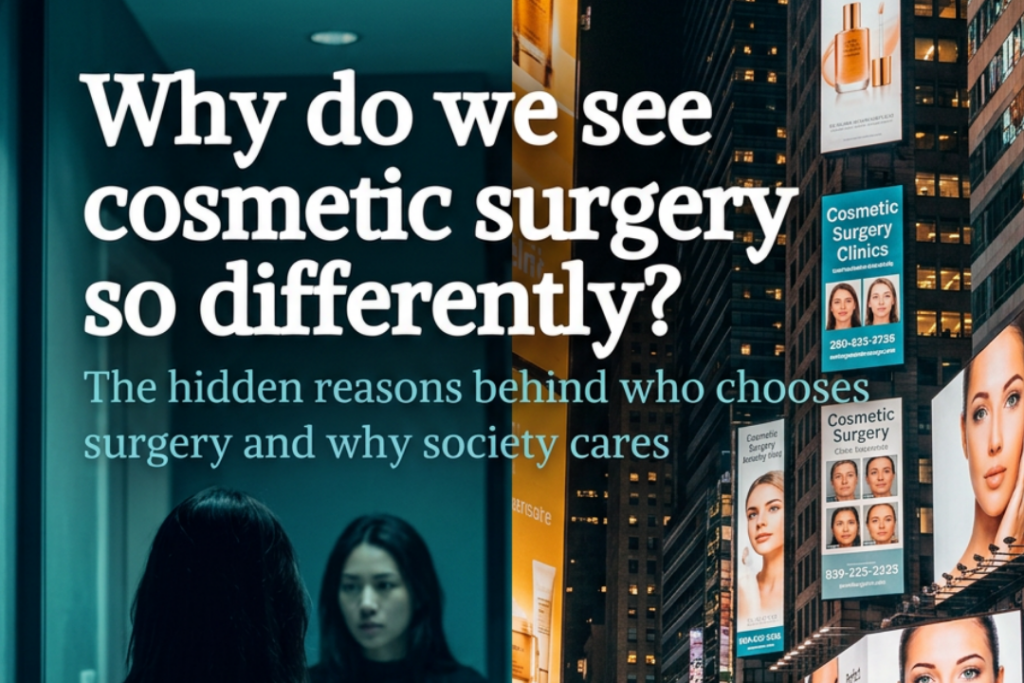
Cosmetic surgery has become an increasingly accepted component of modern healthcare, with millions of procedures performed worldwide each year. Despite its growing prevalence, it remains one of the most socially debated forms of medical intervention. Unlike many other elective healthcare procedures, cosmetic surgery is often accompanied by moral judgement and social stigma. Individuals who choose aesthetic procedures are frequently perceived as vain, insecure, or psychologically vulnerable, whereas reconstructive surgery is widely regarded as a legitimate medical necessity aimed at restoring function or appearance following illness, injury, or congenital conditions.
From a sociological perspective, this disparity raises an important question:
Why is cosmetic surgery viewed differently from other forms of healthcare?
Rather than attributing the decision to undergo cosmetic surgery solely to individual motivations, sociology examines the broader social, cultural, and historical forces that shape perceptions of beauty, identity, health, and self-worth. It considers how societal norms, media representations, gender expectations, and cultural values influence both the decision to pursue cosmetic procedures and the judgements directed towards those who choose them. Through this lens, cosmetic surgery is understood not merely as a personal choice, but as a social phenomenon that reflects the complex relationship between the individual and society.
Cosmetic Surgery as a Social Construction
One of the central concepts in sociology is **social constructionism**, which suggests that beauty is not an objective or universal standard but is shaped by cultural, social, and historical influences. Rather than being biologically fixed, ideals of attractiveness are created and reinforced by society, changing over time and varying across cultures. As societal values evolve, so do perceptions of what is considered beautiful or desirable.
Historical examples demonstrate this concept. In many European societies, pale skin was once associated with wealth and high social status because it indicated freedom from outdoor manual labour. In contrast, during the twentieth century, tanned skin became a symbol of affluence and leisure as international travel became more accessible. Similarly, body size has been interpreted differently across cultures. While fuller body types have historically represented prosperity and health in some societies, contemporary Western cultures often idealise thinness as a reflection of self-discipline, health, and attractiveness.
These beauty ideals are continually reinforced through social institutions and media, including advertising, television, film, fashion, social media, celebrity culture, and peer groups. These influences shape societal expectations and encourage individuals to compare themselves with prevailing standards of attractiveness.
From a sociological perspective, decisions to undergo cosmetic surgery should therefore be understood within this broader cultural context rather than viewed solely as personal choices. Individuals make decisions about their appearance in response to the social norms and values that surround them. Cosmetic surgery is not separate from society but reflects the ways in which cultural expectations influence identity, body image, and perceptions of beauty.
The Body as Social Capital
French sociologist Pierre Bourdieu introduced the concept of capital, proposing that individuals possess different forms of value that extend beyond financial wealth. These include economic, social, cultural, and symbolic capital. Building on Bourdieu’s work, modern sociologists have explored the idea that physical appearance can also function as a form of capital, often described as **body capital** or **aesthetic capital**. Research suggests that individuals who are perceived as attractive may experience advantages across various areas of life, including employment opportunities, career advancement, dating, social acceptance, income, and perceptions of intelligence and trustworthiness. This phenomenon is often referred to as the **”beauty premium.”** Conversely, individuals who do not conform to prevailing beauty standards may experience discrimination, social bias, or reduced opportunities. From this sociological perspective, cosmetic surgery can therefore be understood not simply as an expression of vanity, but potentially as an investment in one’s social and aesthetic capital, particularly within societies where physical appearance can influence social and economic outcomes.
The Influence of Consumer Culture
Modern societies increasingly place an emphasis on self-improvement and personal optimisation, with individuals encouraged to continually invest in themselves through exercise, nutrition, education, fashion, skincare, and cosmetic procedures. Sociologist Anthony Giddens described this process as the **”reflexive project of the self,”** whereby individuals are not expected to view their identity as fixed but are instead encouraged to actively construct, shape, and manage their sense of self throughout their lives. Within this context, cosmetic surgery can be understood as one of many options available to individuals seeking to improve or modify aspects of their appearance and identity. This perspective may help explain why some patients describe cosmetic surgery not as an attempt to change who they are, but as a way of **”becoming the version of myself I always felt I was.”** From this viewpoint, the decision to undergo cosmetic surgery may be understood as part of a broader process of identity formation and self-expression within contemporary society.
Gender Expectations
Approximately 85–90% of cosmetic surgery patients worldwide are women; however, from a sociological perspective, this disparity may reflect broader gender expectations rather than purely individual choice. Women often experience greater social pressure to conform to ideals surrounding youthfulness, thinness, facial symmetry, skin quality, and body shape. Ageing can also be socially perceived differently between men and women. Grey hair in men is often associated with maturity, experience, and leadership, whereas grey hair and visible signs of ageing in women may be more readily associated with declining attractiveness. These unequal cultural expectations may contribute to the higher rates of cosmetic procedures among women. However, cosmetic surgery among men is also increasing, reflecting growing social pressures surrounding masculine ideals, including muscularity, jawline definition, hair restoration, and the maintenance of a youthful appearance. This suggests that while gender differences remain evident, societal expectations surrounding physical appearance increasingly affect individuals of all genders.
Social Media and Digital Culture
Perhaps no social force has influenced cosmetic surgery more significantly in recent years than social media. Platforms such as Instagram, TikTok, and Snapchat have transformed beauty from something encountered occasionally through traditional media into something individuals may see hundreds of times each day. This constant exposure can contribute to social comparison, as people compare their appearance with carefully curated, edited, and filtered images that often present unrealistic beauty ideals. Social media algorithms may further reinforce these standards by promoting content that receives high levels of engagement, which can result in repeated exposure to narrow and often unattainable perceptions of attractiveness. Social media has also increased **self-surveillance**, with individuals increasingly evaluating their appearance through photographs, selfies, and videos rather than relying solely on their reflection. Sociologist Michel Foucault argued that modern societies encourage individuals to regulate and monitor their own behaviour through constant observation. Social media may intensify this process by creating an environment in which individuals are simultaneously the observers and the observed, potentially increasing awareness and scrutiny of their own appearance and influencing attitudes towards cosmetic procedures.
The Stigma Surrounding Cosmetic Surgery
Despite its growing prevalence and increasing acceptance, cosmetic surgery remains subject to significant social stigma. Individuals who undergo cosmetic procedures are often labelled as superficial, narcissistic, insecure, artificial, or attention-seeking. Interestingly, society generally accepts many other forms of body modification and personal enhancement, including orthodontics, hair colouring, makeup, fitness training, tattoos, and laser vision correction. Cosmetic surgery, however, often receives greater criticism because it can challenge cultural beliefs surrounding authenticity, individuality, and the idea that physical appearance should remain “natural.” From a sociological perspective, this reflects the concept of **moral judgement**, whereby certain behaviours are considered socially acceptable while others are viewed as inappropriate or morally questionable. The stigma surrounding cosmetic surgery therefore highlights the inconsistent ways in which society evaluates different forms of appearance modification, despite the fact that many of these practices share similar motivations related to self-expression, confidence, identity, and personal choice.
Cosmetic Surgery and Mental Health: Challenging Misconceptions
One of the strongest stereotypes surrounding cosmetic surgery is the assumption that individuals who undergo these procedures have poor mental health. However, research does not support this generalisation, and most people seeking cosmetic surgery do not have a diagnosed psychiatric disorder. Motivations for undergoing cosmetic procedures are diverse and may include improving body confidence, correcting congenital differences, restoring appearance following pregnancy or significant weight loss, addressing age-related changes, recovering after illness or trauma, or achieving greater congruence between physical appearance and personal identity. Research also suggests that carefully selected patients may experience improvements in body image, self-confidence, quality of life, and social functioning following cosmetic procedures. However, cosmetic surgery should not be considered a treatment for mental illness. Individuals experiencing Body Dysmorphic Disorder (BDD), for example, may remain dissatisfied with their appearance despite technically successful surgery because the underlying psychological distress is not addressed by altering physical features. This distinction is important because choosing to undergo cosmetic surgery does not, in itself, indicate the presence of a mental health condition. Instead, ethical cosmetic practice requires appropriate patient assessment to identify individuals for whom surgery may be unlikely to improve wellbeing due to untreated psychological concerns and to ensure that patients have realistic expectations and are psychologically prepared for the procedure.
Medical Ethics and Psychological Screening
Modern cosmetic surgery places increasing emphasis on the psychological assessment of patients as an important component of ethical and responsible care. Qualified surgeons may evaluate a patient’s motivations for seeking surgery, expectations of the outcome, decision-making capacity, emotional wellbeing, understanding of potential risks, and any existing psychological or psychiatric conditions. The purpose of psychological screening is not to stigmatise individuals who choose cosmetic surgery, but rather to protect patients and support positive outcomes. Appropriate assessment recognises that successful cosmetic surgery depends not only on technical surgical expertise but also on careful patient selection, realistic expectations, informed decision-making, and psychological readiness. By identifying individuals who may require additional support or whose expectations may be unrealistic, healthcare professionals can help ensure that cosmetic surgery is undertaken for appropriate reasons and that patients are adequately prepared for both the physical and emotional aspects of the surgical journey.
Why Does the Stigma Persist?
Sociologists suggest that the stigma surrounding cosmetic surgery persists for several interconnected reasons. Firstly, cosmetic surgery challenges cultural ideas about **”natural beauty”**, as many societies value authenticity and natural appearance while simultaneously rewarding individuals who conform to dominant standards of attractiveness. This creates a contradiction in which people may be encouraged to look attractive but criticised for taking deliberate steps to achieve that appearance. Secondly, society often individualises what are actually broader structural and cultural issues. Rather than questioning unrealistic or narrow beauty standards promoted through media and popular culture, criticism is frequently directed towards individuals who choose cosmetic procedures in response to these pressures. Gendered expectations also contribute to this stigma, particularly for women, who may be expected to maintain a youthful and attractive appearance while simultaneously being judged negatively if they appear overly concerned with their looks. Finally, mental health stereotypes reinforce the stigma, with appearance concerns often being interpreted as evidence of psychological illness, despite limited evidence that cosmetic surgery patients generally have poor mental health when appropriately assessed and selected. Together, these factors demonstrate how social attitudes towards cosmetic surgery are shaped by conflicting cultural values, gender norms, and misconceptions about mental health.
Conclusion
The sociology of cosmetic surgery demonstrates that decisions about appearance are deeply embedded in cultural, economic, and social systems. Cosmetic surgery is not simply about vanity or low self-esteem; it reflects broader issues of identity, gender norms, media influence, consumer culture, and social inequality.
Understanding cosmetic surgery sociologically encourages a shift away from simplistic assumptions. Rather than asking “Why would someone choose cosmetic surgery?”, sociology asks “What social conditions shape that choice?”
This perspective also helps reduce the stigma linking cosmetic surgery with mental illness. While psychological assessment is an essential part of ethical practice, the evidence shows that most patients pursue cosmetic procedures for complex, rational, and highly personal reasons. Recognising these broader social influences allows for a more balanced, evidence-based discussion—one grounded in empathy rather than judgement.
References
Bourdieu, P. (1984). *Distinction: A social critique of the judgement of taste* (R. Nice, Trans.). Harvard University Press. (Original work published 1979)
Davis, K. (1995). *Reshaping the female body: The dilemma of cosmetic surgery*. Routledge.
Foucault, M. (1977). *Discipline and punish: The birth of the prison* (A. Sheridan, Trans.). Pantheon Books. (Original work published 1975)
Giddens, A. (1991). *Modernity and self-identity: Self and society in the late modern age*. Polity Press.
Gimlin, D. (2007). Accounting for cosmetic surgery in the USA and Great Britain: A cross-cultural analysis of women’s narratives. *Body & Society, 13*(1), 41–60. https://doi.org/10.1177/1357034X07074766
Goffman, E. (1963). *Stigma: Notes on the management of spoiled identity*. Prentice-Hall.
International Society of Aesthetic Plastic Surgery. (2024). *ISAPS international survey on aesthetic/cosmetic procedures performed in 2023*. https://www.isaps.org
Jones, M. (2008). *Skintight: An anatomy of cosmetic surgery*. Berg.
National Institute for Health and Care Excellence. (2020). *Body dysmorphic disorder: Recognition and treatment (CG31)*. https://www.nice.org.uk/guidance/cg31
Sarwer, D. B., & Crerand, C. E. (2004). Body image and cosmetic medical treatments. *Body Image, 1*(1), 99–111. https://doi.org/10.1016/S1740-1445(03)00003-3
Sarwer, D. B., & Spitzer, J. C. (2012). Body image dysmorphic disorder in persons who undergo aesthetic medical procedures. *Aesthetic Plastic Surgery, 36*, 999–1009. https://doi.org/10.1007/s00266-012-9921-0
Swami, V. (2009). *The influence of body appreciation on cosmetic surgery consideration*. *Body Image, 6*(1), 16–20. https://doi.org/10.1016/j.bodyim.2008.09.001
Tiggemann, M., & Zaccardo, M. (2018). “Strong is the new skinny”: A content analysis of #fitspiration images on Instagram. *Journal of Health Psychology, 23*(8), 1003–1011. https://doi.org/10.1177/1359105316639436


